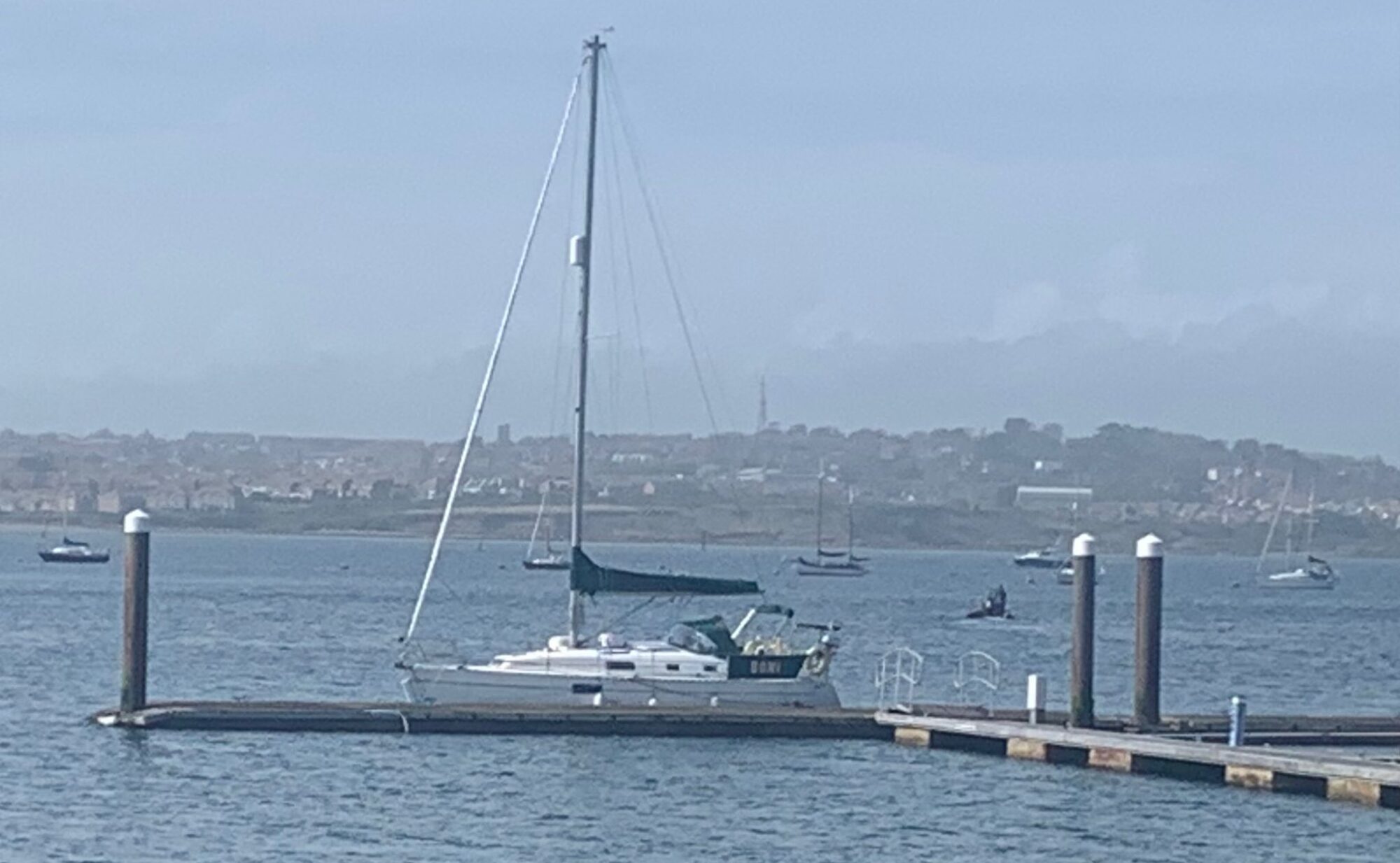
Day 8 (Tuesday 5th May 2026) dawned wet and rainy in Roscoff with not much wind – oh joy! Certainly a day for all the layers – thermals to foulies and wellies etc.
We departed at 10:00 local time to catch the westward tide and make the most of the high water as we wished to proceed through the Canal de Ile de Batz, which dries at low water (the tidal range in these parts is pretty big – c. 7.5 metres). Bob was on navigation, greatly assisted by his newly acquired Savvy Navvy, a navigation programme, whilst I was on the helm, adhering to instructions. The vis. was poor and photos really weren’t an option at this stage. Bob declared that he had never seen so many Cardinal Buoys in such close proximity (neither had I). Cardinal Buoys let you know where the dangers lie, they are all black and yellow: i.e. a northerly cardinal has two cones pointing upwards on the top of it and means that you should pass to it’s North and there is danger – mostly rocks/shallow water – to the south of it.
As we proceeded away from Roscoff and the Ile de Batz greyed into the horizon, a light Nor-westerly breeze picked up and we were able to use this wind with assistance of the motor, so hoisted the mainsail. Our objective was L’Aber Wrac’h, which is accessed via a well-marked and rocky channel. The granite rocks along this northern Brittany coast stick up like teeth and I remember them well since my teenage years when I sailed along here with my dad and his friend Rod. In fact, it was 49 years ago that I last came into L’Aber Wrac’h – the rocks are exactly the same, but the landscape in terms of building has completely changed since 1977. Now there is a marina and many buildings on the shore; last time we cam, we stayed on a swinging mooring buoy.
 Before we got to turn into towards L’Aber Wrac’h, we passed the most impressive duo of lighthouses: Ile de Vierge. The second, taller one was built between 1896 – 1902 and was for a long time, the tallest lighthouse in the world, measuring an astonishing 82.5metres!
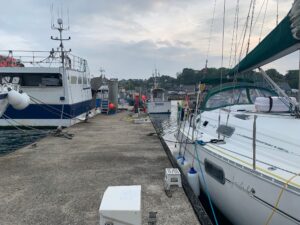 We were greeted by a flotilla of green-sailed mini-catamarans, part of the sailing school here and arrived safely into the harbour. On checking in, we asked if we could move to a different position; to do this we had to get around the rock that is in the middle of the harbour – it is well marked, but it begs the question: why build a harbour with a rock in the middle? So we found ourselves on the pontoon with fishermen and vedettes – busy and a bit smelly!
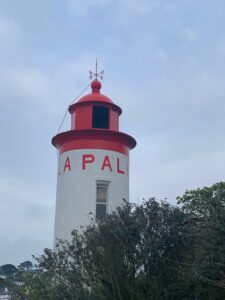
All the new buildings have pretty much put pay to the old leading lights to come into the harbour by: here is La Palue the original forward leading light:
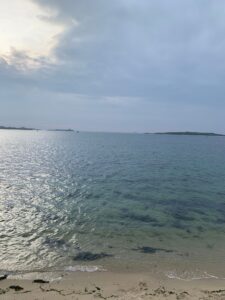
The view towards the sea from L’Aber Wrac’h
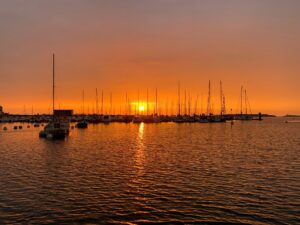
The evening’s sunset did not diasspoint.
Next day (Wednesday) was a day for jobs: cleaning: heads (the loo), galley (kitchen, including the fridge) and floor, fill up with water and on realising today was the last clean pair of knickers, it was also a day to visit the laverie. Here, this consists of two washing machines and a tumble dryer in an open-air cabin, pay by card, includes the washing soap, the wash and drying; all done in less than 2 hours for the sum of 12 Euros. What’s not to like?!
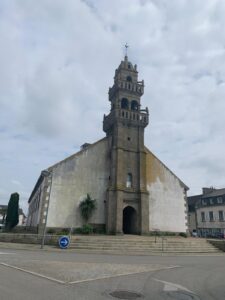 In the afternoon it brightened up so we went out for a cycle ride around the coast, ending up in the nearest small town of Landeda (up a steep hill). Sadly the church – L’eglise Saint Congar was not open; but the supermarket was, so we stocked up on a few essentials!
After another round of Scrabble – Bob was the victor (sigh!) – we strolled along to a local fish restaurant for our evening meal.